English
 русский
 Español

Content
- 1 What Defines a Medium Wire Staple? Technical Classification
- 2 Material Options and Corrosion Resistance
- 3 Medium Wire vs. Heavy Wire Staple — A Direct Comparison
- 4 Application Engineering: Cardboard, Corrugated, and Beyond
- 5 Staple Gun Compatibility and Drive Force Requirements
- 6 Wholesale Sourcing: Pricing, MOQ, and Quality Verification
- 7 FAQ
- 7.1 1. What wire gauge is classified as medium wire for industrial staples?
- 7.2 2. What is the correct leg length for stapling single-wall corrugated cardboard?
- 7.3 3. Can galvanized medium wire staples be used with pressure-treated lumber?
- 7.4 4. What MOQ should I expect when sourcing medium wire staples at wholesale?
- 8 References
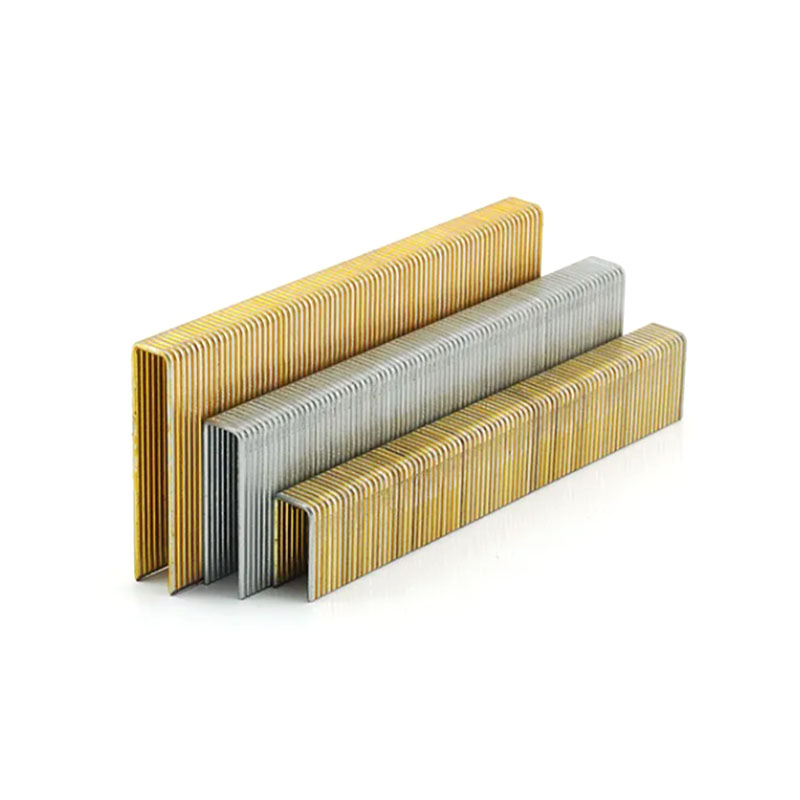
In industrial fastening, packaging, woodworking, and upholstery manufacturing, staple selection directly affects joint strength, substrate integrity, and production line throughput. The medium wire staple occupies a well-defined position in the wire gauge spectrum — strong enough for structural holding tasks in corrugated board, pallets, and furniture frames, yet slender enough to avoid substrate splitting in softwood and paperboard applications. This guide provides a technically grounded evaluation framework for B2B buyers, distributors, and procurement engineers sourcing medium wire staples at volume.
What Defines a Medium Wire Staple? Technical Classification
Staple wire classification is based on wire diameter, expressed in gauge units under the Standard Wire Gauge (SWG) or American Wire Gauge (AWG) system, or directly in millimeters in ISO-aligned specifications. The industry convention in most professional fastening catalogs defines medium wire staples as those produced from wire in the diameter range of approximately 1.05 mm to 1.60 mm (equivalent to approximately 19 to 16 SWG). This range sits between fine wire staples (below 1.05 mm) used in thin materials and heavy wire staples (above 1.60 mm) used in structural timber and pallet assembly.
Wire Gauge, Crown Width, and Leg Length Standards
Three geometric parameters define a staple's mechanical identity: wire diameter (gauge), crown width, and leg length. Each parameter affects a different aspect of fastening performance. Wire diameter determines penetration resistance, withdrawal resistance, and the holding force per staple. Crown width determines the bearing area against the substrate surface and the load distribution across the joint face. Leg length determines penetration depth into the receiving substrate, which is the primary driver of pull-through resistance.
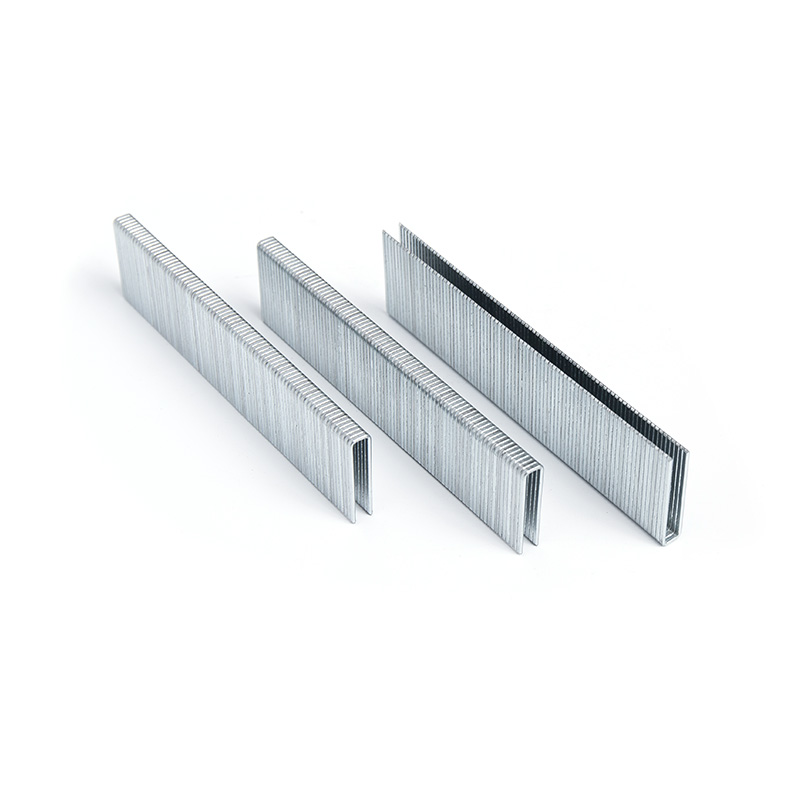
Standard crown widths for medium wire staples range from 5.8 mm to 22 mm, depending on the application series. Narrow-crown series (5.8 mm to 10 mm) is used in cabinet assembly, trim attachment, and furniture production where a small fastener footprint is required. Wide-crown series (16 mm to 22 mm) is used in sheathing, underlayment, and corrugated board applications where the staple must bridge a surface opening or distribute load across a wider contact area.
Medium Wire Staple Gauge and Leg Length Selection Guide
A correct medium wire staple gauge and leg length selection guide approach requires matching the staple's geometry to both the driving substrate and the receiving substrate. The standard rule of thumb for leg length states that the staple leg should penetrate the receiving material to a depth equal to at least twice the thickness of the material being fastened. For a 6 mm thick cardboard panel being fastened to an 18 mm thick wooden batten, the minimum leg length is 6 mm (material thickness) plus 12 mm (2x penetration into batten), which equals 18 mm total leg length.
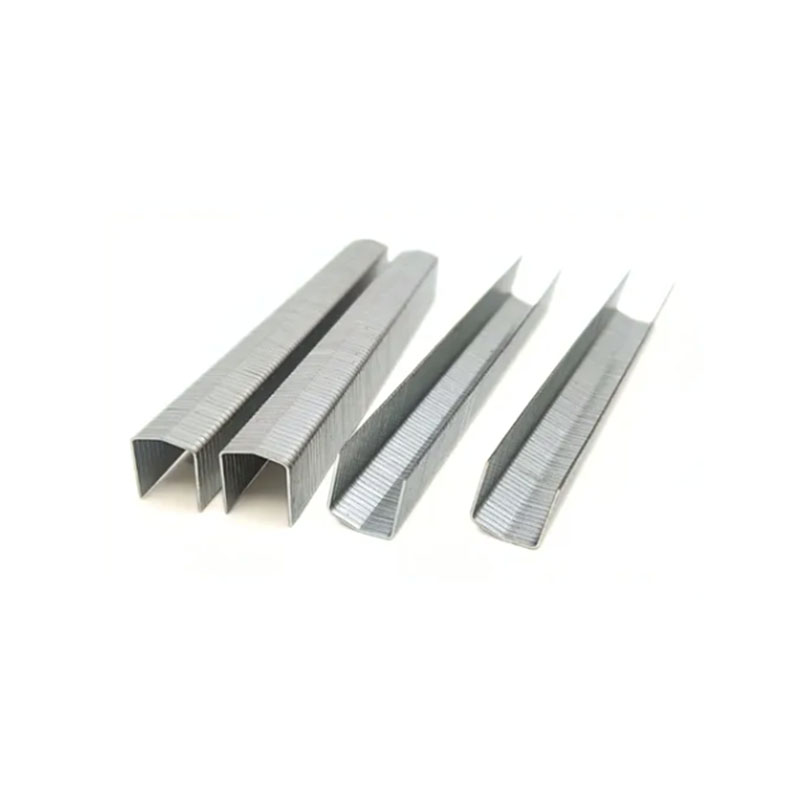
Additional leg length selection considerations for industrial applications include:
- Substrate density: Higher-density substrates (hardwood, dense fiberboard, multi-wall corrugated) require shorter legs than softer substrates at equivalent holding force, because withdrawal resistance per millimeter of penetration is higher
- Clinching applications: Where staple legs are driven completely through both substrates and clinched (bent flat) on the back face, leg length must equal total stack thickness plus 3–4 mm for the clinch foot
- Load direction: Applications subject to pull-through forces (perpendicular to the crown face) require longer legs than applications subject to lateral shear forces
- Substrate moisture content: Wood substrates at moisture content above 19% have lower withdrawal resistance; leg length should be increased by 20–30% relative to dry-condition specifications
Material Options and Corrosion Resistance
Medium Wire Staple Material: Galvanized vs Stainless Steel
Wire material determines the corrosion resistance, hardness, and long-term holding performance of a staple in its service environment. The choice of medium wire staple material,l galvanized vs stainless steel, el is a critical procurement decision for applications in humid, outdoor, or chemically active environments. The table below compares the most commercially significant wire material options across parameters relevant to B2B sourcing decisions.
| Material | Corrosion Resistance | Tensile Strength (typical) | Relative Cost | Primary Application |
|---|---|---|---|---|
| Bright carbon steel (uncoated) | None — indoor dry use only | 600–800 MPa | Lowest | Indoor furniture, light packaging |
| Electrogalvanized steel | Low — light moisture exposure | 600–800 MPa | Low | General packaging, interior woodwork |
| Hot-dip galvanized steel | Good — outdoor and treated lumber | 550–750 MPa | Medium | Pallets, exterior sheathing, roofing |
| 304 Stainless steel | Very good — humid and mild chemical | 700–900 MPa | High | Food packaging, coastal construction |
| 316 Stainless steel | Excellent — marine and chloride-rich | 700–900 MPa | Very high | Marine, offshore, chemical processing |
Hot-dip galvanized staples carry a zinc coating weight of approximately 35–60 g/m2, which provides substantially better corrosion protection than electrogalvanized coatings (typically 10–20 g/m2). For applications involving pressure-treated lumber containing copper-based preservatives (such as ACQ or CA treatments), stainless steel is the only material that resists accelerated galvanic corrosion caused by the elevated copper ion concentration in treated wood.
Medium Wire vs. Heavy Wire Staple — A Direct Comparison
Medium Wire Staple vs Heavy Wire Staple Comparison
The decision between medium wire staple vs heavy wire staple types is most commonly encountered in packaging line design and structural assembly applications. Both wire classes can achieve adequate holding force in many overlapping substrates, but they differ significantly in substrate compatibility, required driving force, tool type, and cost per fastener. The table below provides a side-by-side comparison across the parameters most relevant to production line sourcing decisions.
| Parameter | Medium Wire Staple (1.05–1.60 mm) | Heavy Wire Staple (1.60–2.20 mm) |
|---|---|---|
| Wire diameter range | 1.05–1.60 mm | 1.60–2.20 mm |
| Substrate risk of splitting | Low to moderate | Moderate to high in softwood |
| Required drive force | Medium (pneumatic 5–7 bar typical) | High (pneumatic 7–8 bar or electric) |
| Withdrawal resistance (per unit leg) | Moderate | High |
| Typical application | Corrugated packaging, furniture, and thin pallet boards | Structural pallets, timber framing, heavy crating |
| Cost per 1,000 units (carbon steel) | Lower | Higher |
| Tool compatibility | Wide range of pneumatic and electric staplers | A dedicated heavy-duty stapler is required |
Medium wire staples offer broader tool compatibility and lower per-unit fastener cost, which makes them the preferred specification for high-volume automated packaging lines where tool maintenance and consumable cost are significant operational variables.
Application Engineering: Cardboard, Corrugated, and Beyond
Medium Wire Staple for Cardboard and Corrugated Packaging
The medium wire staple for the cardboard and corrugated packaging segment represents one of the highest-volume end-use markets for this fastener category. Corrugated board stapling must achieve secure joint closure at carton corners and flap interfaces without crushing the flute structure of the corrugated medium, which is the primary load-bearing element in stacked packaging performance. Staple crown width must span the score line at carton corners without penetrating the score valley — a narrow crown of 5.8 to 6.0 mm is standard for most corrugated carton stitching applications.
Leg length selection for corrugated packaging depends on board specification. Single-wall B-flute board (approximately 3.5 mm thick) typically requires a 10–12 mm leg for adequate clinching. Double-wall board (approximately 7–8 mm) requires 14–16 mm legs. Triple-wall heavy-duty board (12–14 mm) is typically stitched with 20–22 mm leg staples in the medium wire gauge range.
Beyond packaging, medium wire staples serve a range of industrial assembly applications:
- Upholstered furniture manufacturing — attaching fabric and webbing to hardwood and engineered wood frames
- Pallet and crate construction — joining thin deck boards to stringers where heavy wire would cause splitting
- Roofing felt and underlayment — wide-crown medium wire staples replace cap nails in many automated installation sequences.
- Wire fencing attachment — medium wire staples driven into fence posts retain the wire mesh under moderate tension loads.
- Agricultural packaging — stapling of vegetable and produce cartons in high-humidity environments, typically using galvanized or stainless wire
Staple Gun Compatibility and Drive Force Requirements
A medium wire staple specification must always be matched to an approved tool from the stapler manufacturer's compatibility chart. Crown width tolerance, wire diameter, and leg length all affect whether a staple feeds and drives correctly in a given tool. Using staples outside the tool's specified range causes misfires, jams, incomplete driving, or tool damage.
Pneumatic medium wire staplers typically operate in the 4.5 to 7.5 bar air pressure range. Drive energy requirements increase with wire diameter, leg length, and substrate hardness. Key tool compatibility parameters for buyers to verify before placing a volume staple order include:
- Crown width tolerance: Most tools accept a ±0.1 mm crown width variance from the nominal specification
- Wire diameter range: Confirm the tool's stated wire diameter range matches the staple wire specification precisely
- Leg length range: Tools have a minimum and maximum leg length for reliable strip feeding and driving
- Strip configuration: Staples are supplied in straight strips or coil format — the tool magazine determines which format is compatible
- Collation adhesive type: Paper-collated versus plastic-collated strips affect the residue left in the substrate and suitability for food-contact packaging.
Wholesale Sourcing: Pricing, MOQ, and Quality Verification
Medium Wire Staple Wholesale Bulk Pricing and MOQ
For buyers evaluating medium wire staple wholesale bulk pricing and MOQ, market pricing is segmented primarily by wire material, crown series, and pack format. Carbon steel medium wire staples in standard narrow-crown and wide-crown series are the highest-volume commodity specification and carry the most competitive wholesale pricing. Galvanized and stainless steel variants command material-based premiums that reflect current wire rod and coating input costs.
Wholesale qualification documentation for a volume staple procurement program should include the following verification requirements:
- Wire diameter certification per lot — request dimensional inspection reports confirming diameter within ±0.02 mm of nominal specification
- Tensile strength test certificate for the wire material — minimum values vary by specification,n but are typically above 600 MPa for carbon steel and 700 MPa for stainless steel grades
- Coating weight certificate for galvanized products — specify minimum zinc coating weight (g/m2) as a contractual requirement, not just a product description.ion
- RoHS and REACH compliance declaration for all wire materials and collation adhesives
- Packaging specification confirmation — strips per box, boxes per carton, and carton gross weight for logistics planning
- Country of origin documentation for import duty classification purposes
FAQ
1. What wire gauge is classified as medium wire for industrial staples?
In professional fastening terminology, a medium wire staple is produced from wire in the approximate diameter range of 1.05 mm to 1.60 mm. This corresponds to approximately 19 to 16 Standard Wire Gauge (SWG). Staples below this range are classified as fine wire, and staples above 1.60 mm wire diameter are classified as heavy wire. The exact boundaries vary slightly between manufacturers and regional standards, so buyers should always confirm the wire diameter in millimeters rather than relying on gauge classification alone when specifying for precision applications.
2. What is the correct leg length for stapling single-wall corrugated cardboard?
For stapling single-wall corrugated board with a total thickness of approximately 3.5 mm (standard B-flute or C-flute), the recommended leg length for a medium wire staple for cardboard and corrugated packaging application is 10 to 12 mm. This provides adequate clinching depth through the board stack while keeping the clinched foot within the board profile. For double-wall corrugated at approximately 7–8 mm total thickness, 14 to 16 mm leg length is the standard specification. Buyers should verify board thickness in their specific packaging specification before confirming staple leg length.
3. Can galvanized medium wire staples be used with pressure-treated lumber?
Standard electrogalvanized medium wire staples should not be used with pressure-treated lumber containing copper-based preservatives such as ACQ (Alkaline Copper Quaternary) or CA (Copper Azole). The elevated copper ion concentration in treated wood accelerates galvanic corrosion of zinc coatings, causing premature fastener failure. Hot-dip galvanized staples offer improved resistance but are still not recommended for permanent structural applications in treated lumber. Stainless steel (304 or 316 grade) medium wire staples are the correct specification for all pressure-treated lumber applications and are mandated by building codes in most jurisdictions for this use case.
4. What MOQ should I expect when sourcing medium wire staples at wholesale?
Wholesale MOQs for medium wire staple products in standard carbon steel specifications typically range from 5 to 20 cartons per SKU from volume manufacturers, with individual carton contents ranging from 5,000 to 20,000 staples depending on the crown series and leg length. Galvanized and stainless steel variants often carry higher MOQs of 10 to 50 cartons due to lower production volumes and material cost sensitivity. Custom specifications — including non-standard crown widths, special coatings, or custom strip formats — typically require MOQs of 50 cartons or more and carry longer lead times of 4 to 8 weeks from order confirmation.
References
- International Organization for Standardization. ISO 10654: Staples for Use in Staplers for Fastening Documents. ISO, 1991.
- European Committee for Standardization. EN 13925-1: Packaging — Corrugated Fibreboard — Part 1: Test Methods. CEN, 2003.
- American Forest and Paper Association. National Design Specification (NDS) for Wood Construction. AWC, 2018.
- ASTM International. ASTM F1667: Standard Specification for Driven Fasteners: Nails, Spikes, and Staples. ASTM, 2017.
- Forest Products Laboratory. Wood Handbook: Wood as an Engineering Material. USDA Forest Service, General Technical Report FPL-GTR-282, 2021.
- International Staple, Nail, and Tool Association. ISANTA Fastener Standards and Specifications Reference Guide. ISANTA, 2019.