English
 русский
 Español

Content
What Wire Gauge and Coating Actually Determine in Heavy Wire Staples
Heavy wire staples are typically made from wire in the 9 to 12.5 gauge range, with lower gauge numbers indicating thicker, stronger wire. A 9-gauge staple resists bending and pull-out far better than a 12.5-gauge staple, which is why fence installers use heavier gauges on high-tension line wire and reserve thinner gauges for lighter mesh or netting applications. Wire thickness directly affects holding power: a 9-gauge staple driven into pressure-treated pine can hold significantly more pull-out force than a thinner staple in the same wood, simply because more metal is engaging the fibers.
Coating matters just as much as gauge once the staples go outdoors. Hot-dip galvanized staples carry a thicker, more durable zinc coating than electro-galvanized versions, and that difference shows up after a few seasons of rain and freeze-thaw cycles — electro-galvanized staples tend to show surface rust first, especially at the point where the coating is thinnest after driving. For coastal installations or anywhere with high humidity, stainless steel staples cost more upfront but avoid the rust streaking that galvanized staples can leave on lighter-colored wood or vinyl posts.
Crown Width and Leg Length: Matching the Staple to the Job
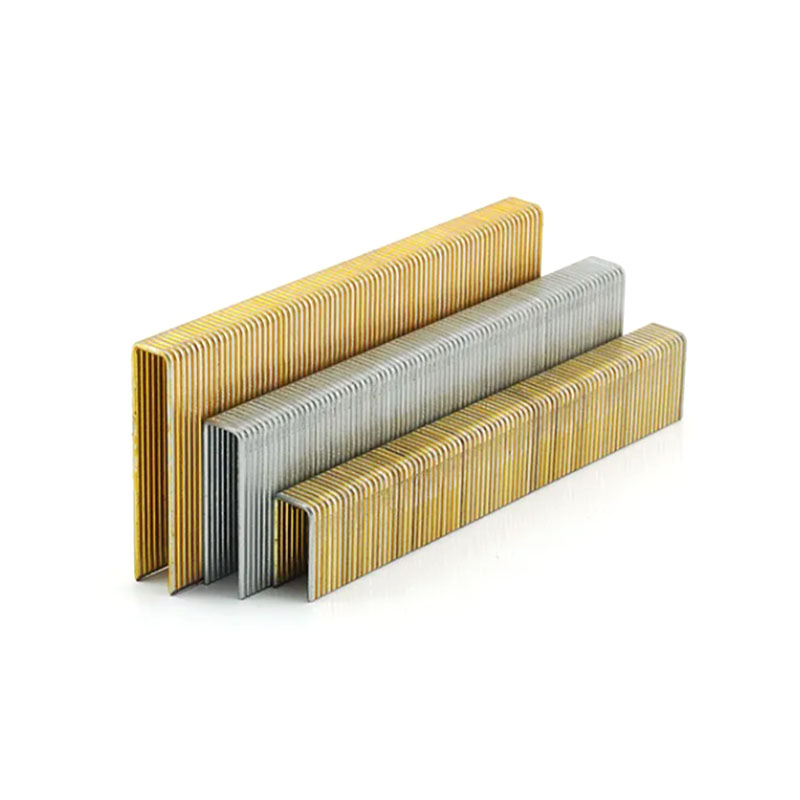
Crown width determines how much wire or material the staple can straddle without crushing it, and leg length determines how deep the staple bites into the substrate. A 1-inch crown is standard for single-strand fence wire, while a wider crown around 1.5 inches is common for stapling mesh, hardware cloth, or insulation facing where the material needs to be held flat across a broader span without tearing.
Leg length should generally run about three times the thickness of the material being fastened, with enough extra length to penetrate solid wood underneath. A staple that's too short will sit loose under tension and eventually work its way out; one that's too long can split thin fence posts or blow through soft insulation board. For softwood fence posts, a 1.5-inch leg is a common baseline, while dense hardwood posts or pallet-grade lumber often call for a shorter, heavier-gauge staple to avoid excessive driving force cracking the wood.
- 1-inch crown, 1.5-inch leg: Standard fence wire on softwood posts
- 1.5-inch crown, 1-inch leg: Mesh, hardware cloth, insulation facing
- 3/4-inch crown, 2-inch leg: Heavy cable or conduit securing
- 1-inch crown, 3/4-inch leg: Pallet and crate assembly
Coating and Finish Options Compared
Choosing the wrong finish is one of the most common reasons heavy wire staples fail prematurely in outdoor applications. Each coating type trades off cost against corrosion resistance differently, and the right choice depends heavily on exposure conditions rather than budget alone.
| Finish | Best Application | Limitation |
|---|---|---|
| Electro-galvanized | Indoor or short-term outdoor use | Thin coating, rusts faster outdoors |
| Hot-dip galvanized | Fencing, outdoor structures | Higher cost than electro-galvanized |
| Stainless steel | Coastal, marine, high-humidity sites | Highest material cost |
| Bright/uncoated | Dry indoor pallet and crate work | No corrosion resistance |
Comparison of common heavy wire staple finishes by application and limitation.
Installation Factors That Affect Holding Strength
Driving angle has a bigger effect on holding strength than most installers expect. A staple driven straight and flush, with the crown seated firmly against the wire or material without crushing it, distributes load evenly across both legs. A staple driven at an angle or over-set into the wood concentrates stress on one leg, which is often where premature pull-out starts under repeated tension from livestock pressure or wind load on fencing.
Wood density and moisture content at the time of installation also affect how well a staple holds long-term. Staples driven into green or wet lumber can loosen significantly as the wood dries and shrinks around the legs, while staples driven into fully seasoned wood tend to hold their grip as the wood's moisture content stabilizes with the surrounding environment.