English
 русский
 Español

Content
- 1 What Makes a Screw a "Sheet Metal" Screw?
- 2 The Types You Will Meet Most Often
- 3 Heads, Drives and Getting a Clean Result
- 4 Materials and Coatings: The Part That Decides Service Life
- 5 Sizing, Pilot Holes and a Few Driving Habits
- 6 Where Sheet Metal Screws Earn Their Keep
- 7 Sheet Metal Screws vs. Their Neighbours
- 8 What We Check Before a Box Leaves the Floor
There is a battered coffee tin on almost every workbench we have ever visited, and it is usually full of short, sharp-pointed screws that have been pulled into a hundred different jobs — a duct seam here, a cabinet back there, a bracket that needed holding while somebody went looking for the right spanner. Those are sheet metal screws, and for such a modest fastener they carry an impressive share of the work.
We have spent decades making collated nails and staples for pneumatic tools, and screws joined our range the way most good things do: one customer asked, then another one did. So this guide is written from the shop floor rather than the catalogue — what these screws really are, how the common types differ, how to size them without guesswork, and where reaching for a different fastener will spare you a call-back.
What Makes a Screw a "Sheet Metal" Screw?
A sheet metal screw is a self-tapping fastener that cuts or forms its own thread as it goes in. It is threaded from just under the head all the way to the point, case-hardened so the thread bites into mild steel instead of rolling over, and finished with a sharp tapered point that helps it start cleanly in a punched or drilled hole.
Two details separate it from its cousins. The thread is coarse relative to the body, which gives more grip in thin material where a fine machine thread would only catch once or twice. And the point is designed for sheet — not for timber, and not for a pre-tapped bore.
The rule we use on the floor is simple: aim for at least three full threads of engagement beyond the last sheet. In practice the screw should be roughly the combined thickness of the parts plus three to five millimetres. It is also worth saying plainly that these are not structural fasteners. For load-bearing connections, use bolts, rivets or welds; sheet metal screws are for panels, covers, ducting, trim and light assemblies.
The Types You Will Meet Most Often
If the label has rubbed off the box, the point tells you most of what you need to know. The table below is the shorthand we use when sorting a mixed tin.
| Type | Point and Thread | Typical Use | What to Watch |
|---|---|---|---|
| Type A | Sharp point, coarse thread | Thin sheet, plastic, soft materials | The older general-purpose pattern |
| Type AB | Sharp point, medium thread | Everyday sheet metal work | Best all-round balance of cut and grip |
| Type B | Blunt point, fine thread | Pre-drilled or tapped holes | Needs a hole to start in |
| Type 17 | Sharp point with auger flute | Timber, MDF, particleboard | Clears chips and resists splitting |
| Self-drilling | Fluted drill point, #1 to #5 | Steel to steel without a pilot hole | Point number must match steel thickness |
| Type F | Machine thread with a point | Joints that will be taken apart again | Cuts a machine-style thread |
Type AB does about eighty percent of the work in a typical fabrication shop. Type A still turns up in older specifications and in soft plastics, while Type B is the one to reach for when the hole is already there and you want a finer, more machine-like thread. Self-drilling screws are really their own subfamily — they drill, tap and fasten in a single pass, which is why they have largely replaced punch-and-screw steps on light steel framing.
Heads, Drives and Getting a Clean Result
Head shape decides how the load spreads and how the finished joint looks:
- Pan head — the general-purpose choice, sits proud of the surface and spreads clamping force well.
- Flat or countersunk head — sits flush, right for faces that will be seen or handled.
- Hex washer head — a built-in washer that widens the bearing area, common on self-drilling screws.
- Truss or wafer head — a wide, low profile that holds thin panels without pulling through.
- Oval head — a countersunk head with a slightly domed top, used where appearance matters.
Drive recess matters just as much. Phillips is everywhere and forgiving, but it cams out under torque. Square and Torx recesses transmit more force with less bit slip, which is why assembly lines handling thousands of screws a shift tend to standardise on them. Whichever you use, match the bit to the recess and replace worn bits early — most chewed-up heads are a tooling problem, not a screw problem.
Materials and Coatings: The Part That Decides Service Life
Most sheet metal screws are case-hardened carbon steel with electroplated zinc. For indoor work in dry conditions that is entirely adequate, and it keeps the cost where it belongs.
Once moisture, treated timber or coastal air enters the picture, the finish becomes the deciding factor. Zinc-nickel and mechanically applied zinc coatings hold up noticeably better than standard bright zinc. Ceramic-filled coatings survive scuffs and salt spray. Stainless steel — 304 for general exterior work, 316 where chlorides are present — removes the corrosion question almost entirely, at a price.
One point we raise with customers again and again: watch the galvanic pair. A stainless screw in an aluminium panel, or a zinc-plated screw in freshly treated timber, can corrode faster than either metal would alone. Isolating washers, a bead of sealant or a compatible coating usually solves it. And when you specify, ask for coating thickness in microns rather than a brand name — that number is what actually protects the joint.
Sizing, Pilot Holes and a Few Driving Habits
Gauges run from about #4 to #14, roughly 2.8 to 6.3 mm, with metric equivalents around M3 to M6. Lengths commonly start at 6 mm and run past 50 mm. Flat head screws are measured overall, other heads from under the head to the point — a small detail that causes a surprising number of short orders.
Pilot hole sizes that cover most shop work:
- #6 screw — 2.4 mm (3/32 in)
- #8 screw — 2.8 mm (7/64 in)
- #10 screw — 3.2 mm (1/8 in)
- #12 screw — 3.5 mm (9/64 in)
- #14 screw — 4.0 mm (5/32 in)
Below about 0.8 mm sheet you can often skip the pilot entirely and simply dimple the surface with a punch so the point does not wander. Beyond that, a pilot hole of roughly root diameter gives a cleaner cut and less distortion of the panel.
Driving habits make the difference between a neat row and a mangled one. Set the clutch low and let the screw cut at its own pace; running a driver flat out on thin sheet just spins the point and work-hardens the metal. Keep pressure steady and in line with the screw — angling the tool ovalises the hole. A touch of wax helps stainless considerably, and never re-drive into a stripped hole; move a few millimetres and start again.
Where Sheet Metal Screws Earn Their Keep
Ductwork and HVAC is the classic home: seams, flanges, hanger brackets and access panels. From there the list widens quickly — electrical enclosures, appliance back panels, gutters and downpipes, metal roofing and cladding, sign frames, vehicle trim, cabinet backs, shop fittings and display units.
They also work nicely in wood, though for particleboard and MDF a Type 17 point is the better partner because the auger flute clears the chip instead of packing it. Dense fibre board and cement board are a different story again: those need a screw with a drill point and ribs under the head so the board countersinks cleanly without crumbling.
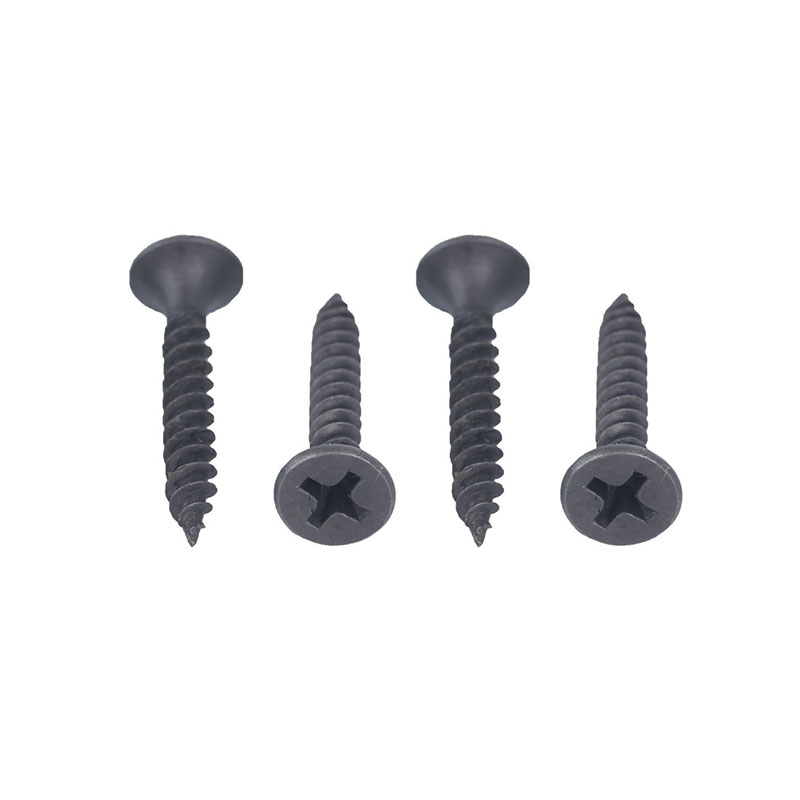 Carbon Steel Fibre Screws for Board and WoodCarbon steel screws with fibre-enhanced corrosion resistance, available in fine- and coarse-thread types for indoor and outdoor fastening.View Product →
Once you move away from plain sheet into board products, the fastener changes with the material — and so does the torque setting on the tool.
Sheet Metal Screws vs. Their Neighbours
Drywall screws get borrowed for metalwork constantly, and it rarely ends well. They are hardened to a brittle level, with a bugle head and a coarse thread meant for gypsum. Drive one into a steel stud and the shank snaps. If you want the detail, this piece on why drywall screws behave the way they do explains the difference in heat treatment.
Drywall Screws with Bugle Head and Self-Drilling PointFor gypsum board installation, these self-drilling screws have bugle heads for flush seating and come in fine or coarse thread.View Product →
Machine screws are the other common comparison. They need a nut or a tapped hole, but they can be undone repeatedly and they handle vibration far better than a thread cut into thin sheet. For equipment panels that will be serviced, a machine screw and a captive nut is often the more professional answer. Rivets, meanwhile, suit joints where you have access from one side only and never want the fixing to come loose.
What We Check Before a Box Leaves the Floor
Most field failures trace back to manufacturing rather than installation. A screw that snaps at the collar has usually failed heat treatment; one that spins without biting has a point that is off-centre or a thread that was rolled too shallow. So we look at point concentricity, thread form, hardening depth, plating thickness and how cleanly the drive recess was formed — because a recess that strips at half torque wastes everybody's afternoon.
We are nail and staple makers first, and the screw line grew out of customers wanting one shipment, one set of documents and one conversation. It now covers drywall screws, fibre screws, anti-loosening floor screws and slotted flat head machine screws, alongside the collated fasteners we have been producing for decades.
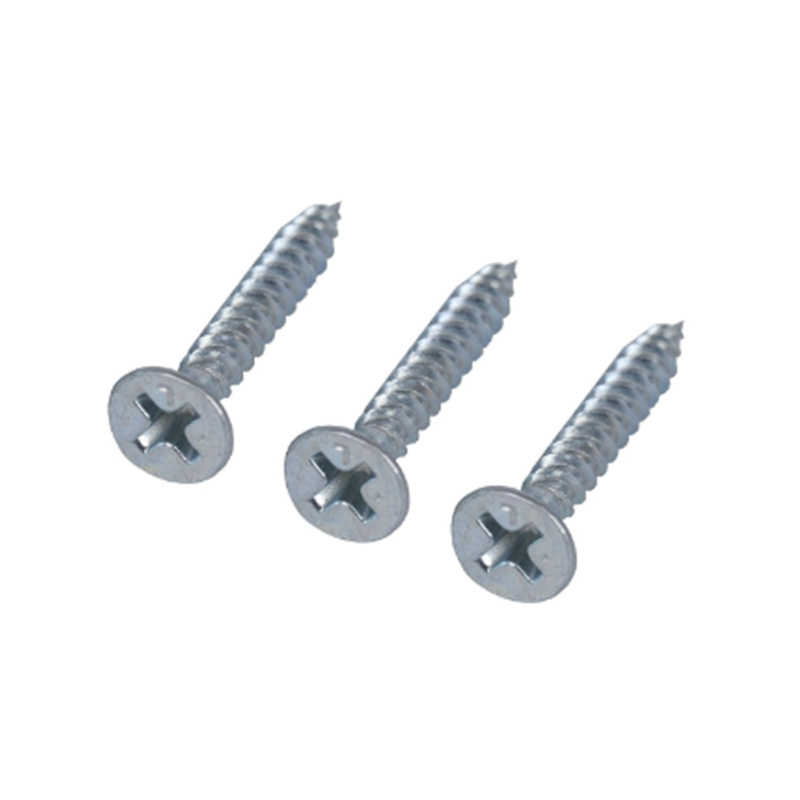 Slotted Flat Head Galvanized Machine ScrewsGalvanized slotted flat-head screws for furniture assembly and general fastening, available in 16–50 mm lengths with fine or coarse threads.View Product →
If you are not sure which thread form suits your panel, send us the material thickness, the substrate and a photo of the joint. That is usually enough for us to point you in the right direction — and you can browse the wider range on our home page.
None of this is complicated, but the small decisions add up: the right point for the material, three threads of engagement, a coating that matches the environment and a driver clutch that is not set to maximum. Get those four right and the tin on the bench stays a helpful habit rather than a source of mystery.