English
 русский
 Español

Content
- 1 The Bottom Line: When to Choose Steel Galvanized Staples
- 2 What Makes a Staple Galvanized
- 3 Coating Comparison at a Glance
- 4 Steel Galvanized Staples vs. Stainless Steel: A Practical Decision
- 5 Gauge, Crown, and Leg Length: Matching the Staple to the Material
- 6 Top Applications Where Galvanized Staples Excel
- 7 Installation Factors That Determine Long-Term Performance
- 8 How to Read Galvanized Staple Specifications on Packaging
- 9 Cost-Effectiveness Over the Project Lifetime
The Bottom Line: When to Choose Steel Galvanized Staples
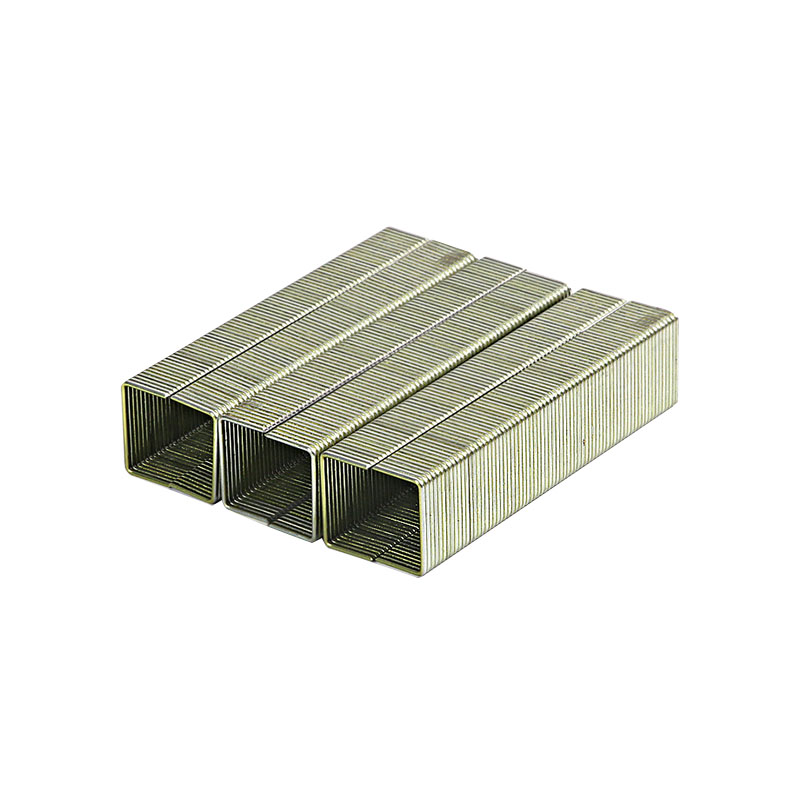
For fastening in moisture-prone or outdoor environments, steel galvanized staples provide the most practical balance of cost, strength, and corrosion resistance. Their zinc coating acts as a sacrificial barrier, preventing red rust on the underlying steel for years even in intermittent wet conditions. Unless the application involves continuous saltwater immersion or highly acidic chemicals, galvanized staples outperform uncoated steel and offer a longer service life than many assume.
Field data from fastener coating comparisons shows hot-dip galvanized staples consistently achieve over 1,000 hours in salt spray testing (ASTM B117) before significant rust appears, while standard electro-galvanized variants typically reach 100–300 hours. This means a properly selected galvanized staple can keep a fence, roofing underlayment, or insulation secured for a decade or more in normal outdoor exposure.
What Makes a Staple Galvanized
Galvanization bonds a layer of zinc to the steel wire. Two coating methods dominate the staple market, each affecting performance, price, and ideal use case.
Electro-Galvanized Coating
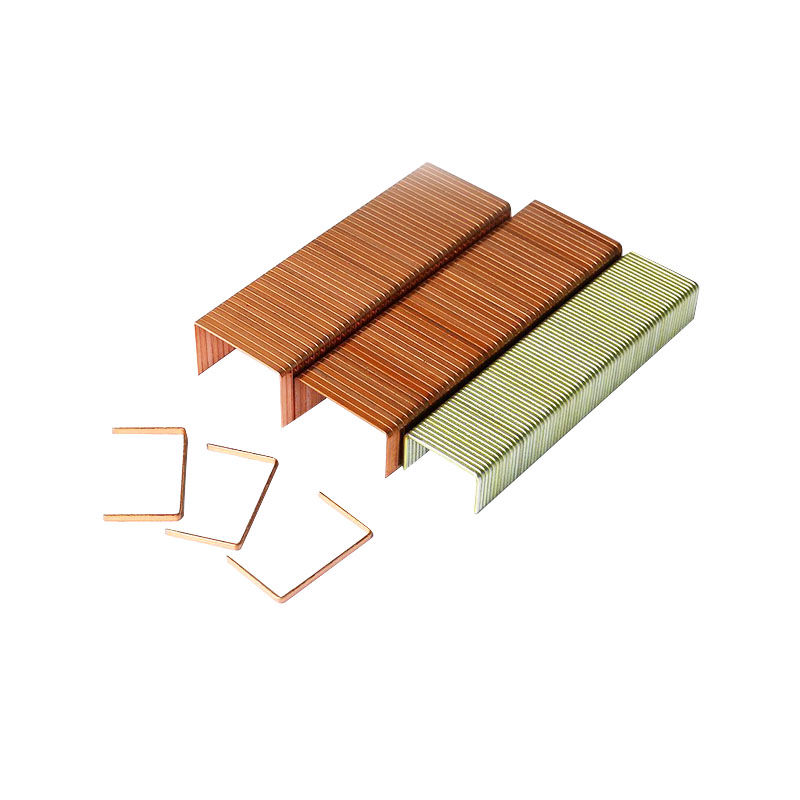
A thin, uniform zinc layer is applied through electroplating. The coating thickness usually falls between 0.2 and 0.5 mils (5–12 microns). The surface is smooth and bright, which reduces friction during driving and works well in fine wire staples for upholstery, crafts, and indoor construction. However, the thin coating offers limited outdoor durability and can be scratched more easily.
Hot-Dip Galvanized Coating
The staple is immersed in molten zinc, producing a thicker, metallurgically bonded layer of 1.5 to 3.0 mils (38–76 microns) or more. The surface has a matte, crystallized pattern. This heavy coating withstands harsh weather, condensation, and prolonged contact with treated lumber. For fencing, roofing felt, and exterior sheathing, hot-dip galvanized staples deliver the longest maintenance-free life.
Coating Comparison at a Glance
| Coating Type | Zinc Thickness | Salt Spray Resistance | Best Application Environment |
|---|---|---|---|
| Electro-Galvanized | 0.2 – 0.5 mils | 100 – 300 hours | Indoor, low-moisture, light outdoor exposure |
| Hot-Dip Galvanized | 1.5 – 3.0+ mils | 1,000+ hours | Exterior construction, pressure-treated wood, coastal areas |
The table highlights why simply “galvanized” is not enough detail for specification. Knowing the coating technology prevents premature rust failures on critical jobs like roof underlayment or fence board attachment.
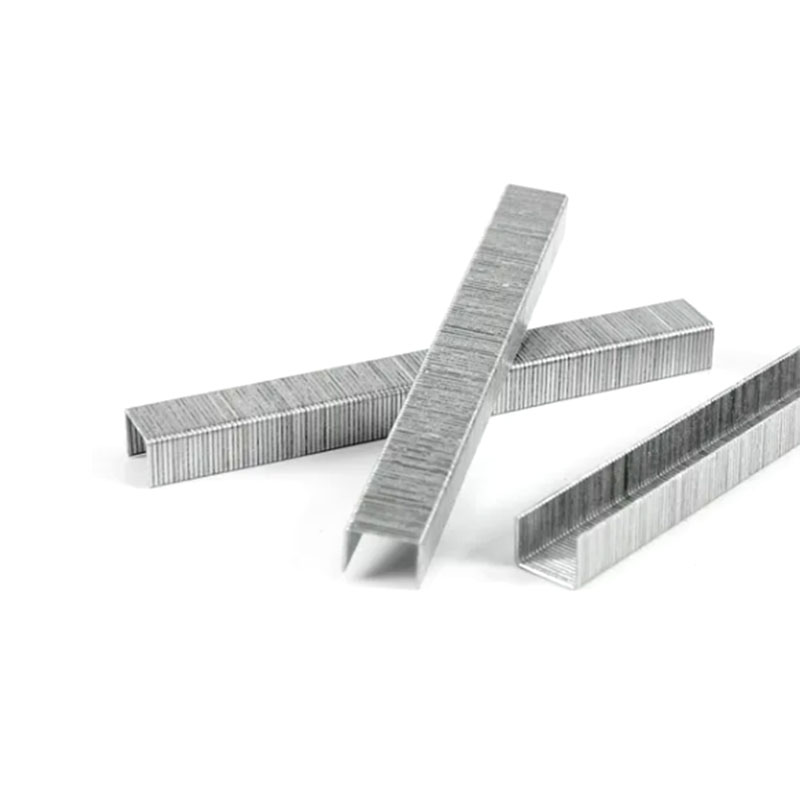
Steel Galvanized Staples vs. Stainless Steel: A Practical Decision
Stainless steel staples (304 or 316 grade) offer superior corrosion resistance, but they cost 3 to 5 times more than hot-dip galvanized equivalents. For the vast majority of outdoor wood and fabric fastening tasks, this premium is hard to justify.
Real-world replacement data from fencing contractors indicates that hot-dip galvanized staples hold structural integrity on cedar and treated pine fences for 15–20 years in temperate climates, aligning well with typical fence board lifespan. Only within 500 meters of breaking surf or in constant chemical exposure does the switch to 316 stainless become a clear necessity. In all other cases, choosing a heavy zinc coating eliminates the expense without sacrificing the service interval.
Gauge, Crown, and Leg Length: Matching the Staple to the Material
Selecting the right steel galvanized staple is as much about dimensions as it is about coating. Common wire gauges range from 16 gauge (0.051 inch thick) for heavy construction to 20 gauge (0.034 inch) for insulation and light fabrics.
- Narrow crown (3/16 inch to 1/4 inch) staples concentrate holding force and are ideal for fence pickets, trim, and edge fastening where splitting must be minimized.
- Medium crown (5/16 inch to 3/8 inch) staples deliver a broader grip for roofing felt, house wrap, and wire mesh, resisting pull-through better under wind uplift.
- Wide crown (7/16 inch and above) staples secure insulation and flexible ducting, distributing clamping force without tearing thin substrates.
Leg length should penetrate the base material by at least 1.5 times the thickness of the fastened item. For instance, securing 1/2-inch plywood sheathing calls for a staple leg length of 3/4 inch or longer. Too short a leg reduces withdrawal resistance sharply; a test by the Virginia Tech wood engineering lab showed that increasing embedment from 1/2 inch to 3/4 inch boosted withdrawal capacity by over 70% in southern yellow pine.
Top Applications Where Galvanized Staples Excel
Steel galvanized staples occupy a specific performance band across construction, agriculture, and upholstery. The zinc coating prevents staining and rust bleed that would ruin fabric, while the steel core remains rigid enough to drive consistently.
Fencing and Outdoor Structures
Barbed wire, woven wire, and welded mesh fencing rely on 9/16-inch or 3/4-inch leg hot-dip galvanized staples. The coating survives decades of rain and sun. When driven into pressure-treated posts with high copper content, the thick zinc layer resists galvanic corrosion far better than electro-plated fasteners.
Roofing Underlayment and House Wrap
Synthetic underlayments and asphalt felt are fastened with divergent-point galvanized staples, typically 1/4-inch crown and 3/8-inch to 1/2-inch leg. The hammer-tacker or pneumatic stapler speed is essential, and the staples must not rust through the roof covering. Manufacturers such as DuPont specify minimum ASTM A653 G60 coating for Tyvek wrap staples, which equates to a hot-dip zinc weight of approximately 0.6 oz/ft².
Upholstery and Automotive Trim
Fine-wire electro-galvanized staples (20 or 21 gauge) with a 3/16-inch crown are the industry standard for attaching fabric to wooden frames. The thin, smooth coating prevents rust stains on light-colored upholstery while driving flush without splitting thin hardwood.
Installation Factors That Determine Long-Term Performance
Even the best steel galvanized staples fail prematurely if driven incorrectly or stored improperly. Attention to three details makes the difference.
- Drive energy and crown setting: Over-driving fractures the zinc layer and exposes bare steel. Set the staple crown flush with the surface. Pneumatic tool pressure for 16-gauge staples into softwood typically sits at 70–90 PSI, depending on wood density.
- Storage conditions: Galvanized staples stored in unsealed boxes in humid sheds can develop white rust (zinc oxide) within weeks. Keep them in low-humidity, sealed packaging until use. White rust itself is not structural failure but indicates the sacrificial zinc has started corroding.
- Wood treatment compatibility: Alkaline copper quaternary (ACQ) and copper azole treated lumber are aggressive toward zinc. For these materials, specify hot-dip galvanized staples with a minimum coating weight of G185 (1.85 oz/ft²) per ASTM A153 for fasteners, which substantially extends life compared to standard G60 or G90 coatings.
How to Read Galvanized Staple Specifications on Packaging
Manufacturers often use shorthand. A label reading “GALV 16GA 1/4×3/4” indicates a galvanized steel staple, 16 gauge wire, with a 1/4-inch crown and a 3/4-inch leg length. If the word “HD” or “HOT” appears, it signifies a hot-dip coating. Look for references to ASTM standards: ASTM A653 for the steel sheet zinc coating or ASTM F1667 for driven fastener properties. An explicit mention of “Meets ASTM A153 Class D” signals the thickest, most durable hot-dip galvanizing intended for harsh environments.
Bulk staple products sometimes list only gauge and length. In those cases, assume electro-galvanized unless the price point is significantly higher, which reflects the additional zinc mass of hot-dip processing.
Cost-Effectiveness Over the Project Lifetime
Comparing per-unit cost alone misses the full value of steel galvanized staples. A study by the National Association of Home Builders calculated that the labor to replace prematurely rusted fasteners on a 2,000-square-foot roof deck exceeded $3,200 in equipment and man-hours, while the upgrade from electro-galvanized to hot-dip galvanized staples for the entire job added less than $85 in material cost. The long-term saving is clear for any exterior project.
When the staples remain hidden behind siding, roofing, or insulation, the zinc coating’s job is to outlast the visible assembly. Choosing the right galvanized staple at the specification stage becomes one of the lowest-cost insurance policies in construction.